


Check this before you book anything
2026 hasn't been a normal year for the region. Tensions earlier in the year disrupted flights and shut some attractions for a time. Things have calmed: the UK, US, Australia and Canada are among the countries that have eased their travel advice since mid-June. Airlines are a different matter, because a number of international carriers have extended their Dubai cancellations into October, November or even January 2027.
Read your own government's current guidance. Confirm your airline actually flies the route. Pick flexible bookings. It's the least exciting section of this article and probably the most important.
1. Burj Khalifa, at sunset
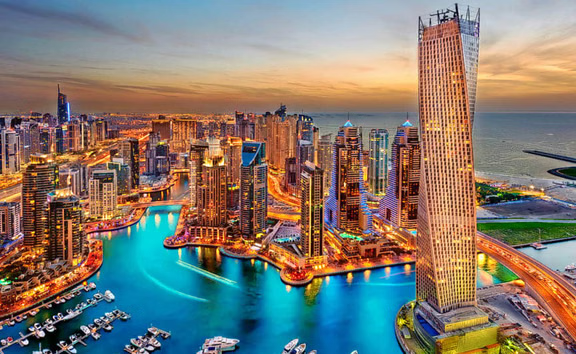
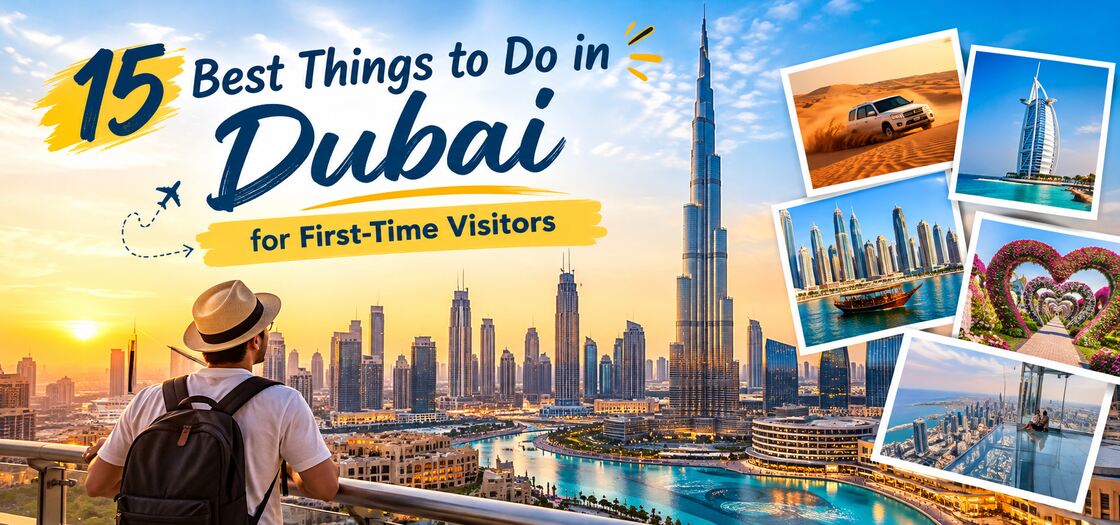
Yes, it's the obvious one. At 828 metres it's the tallest building in the world, and standing at the base with your neck bent back is a little humbling. The main decks are on floors 124 and 125. Level 148 costs a good deal more, but you get a lounge, a terrace and fewer elbows around you.
What matters more than the floor is the time. Midday views tend to be hazy and flat. Sunset is when the towers go copper and the city starts switching its lights on. Book a few days ahead, because those slots disappear. Leave an hour, maybe ninety minutes.
2. The Dubai Fountain
It's free, it's next door, and it's good. The show runs every 30 minutes between 6 and 11 PM, firing jets up to 150 metres high to a mix of Arabic, classical and pop tracks.
You can stand on the promenade and get splashed by the atmosphere, or book a lakeside table and watch while you eat. Holiday periods like Eid can change the schedule, so check if your dates overlap.
3. Dubai Frame
A giant golden picture frame, 150 metres tall, planted in Zabeel Park. Looks silly in photos, works well in person. One side shows you older low-rise Dubai, the other faces the glass towers of Downtown, and standing on the bridge between them tells you more about the city's speed than any museum label could.
Forty-five minutes to an hour is enough. Confirm it's open on your dates.
4. The Gold and Spice Souks
Deira is where the old trading city still shows through. The Gold Souk is a covered maze of shop windows stuffed with jewellery. Walk a few minutes and the Spice Souk finds you by smell first: saffron, dried limes, frankincense, loose tea in open sacks.
Haggle, especially on anything that isn't gold. For gold, check the day's rate before you walk in, since pricing is usually by weight. Late afternoon, when the heat lets up, is the best time. About two hours covers it.
5. An abra across the creek
A few dirhams. A few minutes. And for those few minutes the skyline vanishes and you're among old trading boats and wind-tower buildings. It's probably the cheapest good thing you can do in the whole city.
The boat stops sit right by the souks, so pair them.
6. Al Fahidi
Narrow lanes, coral-and-gypsum houses, and wind towers that cooled people's homes long before anyone had air conditioning. Many of the old courtyards are now small galleries and cafés, so wandering in and out without a plan is the whole point.
The Dubai Museum inside Al Fahidi Fort adds some background on pearling and trade. Opening hours do change, so check first. Give the area a couple of hours, and don't schedule anything tight right after it, because it's the sort of place you linger.
7. Dinner at Al Seef
Along the creek, Al Seef pairs old-style architecture with newer restaurants, and it's a good place to try Emirati food for the first time. Look for machboos (spiced rice with meat), harees, and luqaimat, which are little fried dumplings with date syrup.
Have one meal somewhere casual and order karak chai. It's strong, sweet and spiced with cardamom, and half the city seems to run on it.
8. Desert safari (pick your operator carefully)
For many first-timers, this is the day that feels most like Arabia. Tours usually pick you up in the afternoon, head out to the dunes for the dune bashing, then carry on to a camp for dinner and a show. An evening trip takes five to six hours. Morning versions are shorter and gentler.
Be honest with yourself about the ride, though. It's bumpy and fast. If you get carsick, or you're travelling with toddlers or older relatives, ask for a calmer option or skip it. Quality varies wildly between companies, so recent reviews beat the cheapest price. The cooler months, November to March, are the comfortable ones. Wear closed shoes you won't mind filling with sand.
9. Skydiving over the Palm
Tandem skydiving above Palm Jumeirah is Dubai's headline adrenaline hit. You fall for about a minute, then glide down with the island's outline and the coastline spread out underneath.
Not jumping? The drop zone has a relaxed café where you can sit and watch other people do it, which many find more fun than expected. Weather can cancel jumps, so book early and keep a spare day. Ask about health and weight limits before you pay.
10. Ski Dubai
Skiing indoors when it's 40°C outside sounds like a joke, and then you're standing in real snow wearing a rented jacket and laughing. Ski Dubai, inside Mall of the Emirates, has easy beginner slopes, a snow park for sledding, and a penguin encounter.
Jackets and boots are normally included, but gloves and socks sometimes aren't, so read what your ticket covers. A good rainy-day substitute, except it never rains.
11. The Dubai Mall
"Mall" doesn't quite cover it. There are luxury brands and the usual high-street names, sure. There's also a walk-through aquarium tunnel, an ice rink, and more places to eat than you could work through in a week.
You don't have to shop. Two or three hours gives you a decent wander, and the fountain show is right outside, so end there.
12. Palm Jumeirah and Atlantis
An artificial island shaped like a palm tree, lined with resorts, beach clubs and restaurants. A monorail connects the base to Atlantis at the far end, and viewing spots like The View at The Palm show the island's shape properly, which you simply can't grasp from ground level.
Families who love water rides should look at Atlantis Aquaventure. Everyone else can get away with a sunset dinner on the island.
13. A beach afternoon on Jumeirah
You don't need a hotel pass for Dubai's coastline. Public beaches like Jumeirah Beach and Kite Beach are free or cheap, and the sail-shaped Burj Al Arab sits in the background looking pleased with itself.
If you'd like some cultural context while you're in the area, Jumeirah Mosque offers guided visits for non-Muslim visitors. Cover up and check visiting times in advance.
14. Dubai Miracle Garden
Millions of living flowers shaped into arches, tunnels and sculptures, in a place where you'd expect sand. Sounds gimmicky. The scale tends to win people over anyway. Season 15 opened on October 8, 2026, and the garden is open seasonally from October to May.
Go in the morning while it's cool and the photo spots are quiet. Two hours is plenty, and the Butterfly Garden next door is an easy add-on.
15. Global Village
Imagine a fairground, a street-food market and a world bazaar squeezed into one site. Pavilions from dozens of countries, rides, stage shows, and a lot of snacking. The 31st season opened on Wednesday, October 14, 2026, and runs through May 2027. Tickets have generally been Dh25 from Sunday to Thursday and Dh30 on Fridays and Saturdays, but check the official site for current prices.
Arrive late afternoon and stay for dinner. Weekdays are far calmer than weekends.
What about the Museum of the Future?
It's on nearly every itinerary, so here's a heads-up. The museum announced a temporary closure from 1 September 2026 until further notice. Check its official site before planning a day around it.
When to go
November to March is the comfortable stretch: mild days that suit the desert, the beach and long walks. It's also the most expensive, especially around New Year.
April and May can work if you stick to mornings and evenings. June to September is very hot and humid, although flights and hotels are often cheaper and indoor places keep running normally. If summer is your only option, plan around malls, the aquarium, Ski Dubai and late nights.
How many days?
Four or five days suits a first visit. One sensible layout:
| Day 1 | Burj Khalifa, Dubai Mall, fountain show |
|---|---|
| Day 2 | Al Fahidi, the abra, the souks, Al Seef |
| Day 3 | Palm Jumeirah and the beach, or Ski Dubai |
| Day 4 | Desert safari |
| Day 5 | Dubai Frame, Miracle Garden or Global Village, or a day trip to Abu Dhabi |
Small things worth knowing
Dress is relaxed, but cover shoulders and knees in malls, souks and religious places. Swimwear is for beaches and pools. The UAE weekend is Saturday and Sunday, and some venues run shorter hours on Friday around midday prayers.
The metro is clean and cheap. Taxis and ride-hailing apps handle the Palm and the desert. Keep public displays of affection low-key, and be careful about photographing people or government buildings. If your trip falls in Ramadan, the dates move every year and daytime eating in public may be restricted, though evenings are lively. Carry water and sunscreen even in winter. The sun is stronger than it feels.
FAQs
What are the best things to do in Dubai for first-time visitors?
The Burj Khalifa, the Dubai Fountain, a desert safari, the old souks and Al Fahidi, the Dubai Mall and Palm Jumeirah.
How many days are enough?
Four to five days is comfortable. Add one if you want Abu Dhabi.
When is the best time to visit?
November to March, when the weather suits outdoor plans.
Is Dubai good for families?
Yes. Ski Dubai, the aquarium, Miracle Garden, Global Village and the beaches all work with kids.
Is Dubai expensive?
It can be. The fountain, public beaches, abra rides and Old Dubai cost very little, while luxury dining and peak-season hotels push prices up.
Should I book a Dubai tour package?
It saves effort on a short trip because tickets and transfers are sorted. Going independent gives you more freedom. It depends how much planning you enjoy.
Final thoughts
What people remember from Dubai tends to be small. A boat ride that feels decades away from the skyline. A glass of karak chai a few streets from a luxury tower. A quiet courtyard in Al Fahidi after a loud day in the dunes. Choose a handful of experiences from this list, leave gaps for wandering, and recheck the travel situation before you pay for flights. That's a better plan than any checklist.







 +91 9999316597
 info@fliptrip.in
 +91 9999316587
 806 A09,
ITL, Northex Tower, NSP, Pitampura
806 A09,
ITL, Northex Tower, NSP, Pitampura


