
TRENDING DESTINATIONS
Last updated on: 25 Sep, 2026

If you've been comparing options for a new Scandinavia tour package lately, you've probably run into the same problem a lot of our travelers mention to us. Most of what's online is either a bare package list with a price tag on top, or a blog written by someone who's clearly never planned a trip with a toddler in a stroller or a grandparent who needs a slower pace. At Flip Trip Holidays, that's the gap we wanted to fix here. So this is a straight answer on the best Scandinavia tour packages for families: which cities actually deserve your time, how the fjords work, what getting around looks like day to day, and what this trip realistically costs once you're booking from India.
One thing worth clearing up first. Scandinavia, in the strict sense, means Norway, Sweden, and Denmark. Not Finland, not Iceland, whatever a package brochure might tell you.
A lot of Indian travel sites lump Finland and Iceland into "Scandinavia" too. Technically that's not accurate. Scandinavia refers specifically to Norway, Sweden, and Denmark. Finland and Iceland belong to the wider Nordic region, which is related but not the same thing. This matters for more than trivia reasons. If a package advertises "Scandinavia" and then quietly swaps in three days of Helsinki instead of proper time in the fjords, you're not getting what the name promised. So for this guide, we're sticking to the three core countries, since that's what most families mean anyway when they ask about a Scandinavia trip.
Most family itineraries begin in Copenhagen, and there's a reason for that. It's compact, the trams and metro are stroller-friendly, and there's enough variety here to hold both a toddler's attention and a teenager's. Tivoli Gardens sits right in the city center. It's one of the oldest amusement parks anywhere, and it still feels current, not dated. Rides for younger kids, gardens where the adults can sit down, and once the sun goes down, the lights across the park make for a proper evening out. Nyhavn's harbor front, with its row of colorful buildings, is where most families end up taking half their photos, planned or not. A short canal cruise is an easy way to see more of the city without a lot of walking.
Three nights here is usually enough.
Oslo is quieter and smaller than Copenhagen, and it works well as a two-night stop before you head into fjord country. The Vigeland Sculpture Park costs nothing to enter and spreads across open lawns with over 200 bronze sculptures on display. Kids tend to run around freely here, which parents usually appreciate after a day of museums. One thing to plan around: the Viking Ship Museum has been closed since 2021 for a major rebuild and isn't expected to reopen until 2027, so don't build your Oslo day around seeing the original Oseberg and Gokstad ships in person right now. For Viking history in the meantime, the Historical Museum in the city center holds the Oseberg gold and burial artefacts, and Viking Planet nearby runs a short VR longship experience that kids tend to enjoy more than a standard museum walk-through. If your family likes a hands-on story over glass display cases, the Fram Museum is also worth the trip, built around a real polar exploration ship you can actually walk through.
Stockholm is spread across fourteen islands, which on its own makes it interesting to get around with kids. Hopping ferries between neighborhoods feels less like transport and more like a small outing each time. The Vasa Museum, built around a nearly intact 17th-century warship pulled straight out of the harbor, is one of those rare places that both a seven-year-old and a grandparent will find genuinely interesting. Skansen, an open-air museum with Nordic animals and old Swedish village life on display, is another easy choice for the younger travelers in the group.
If Copenhagen, Oslo, and Stockholm are your cities, Bergen is the doorway into the landscape people picture when someone says "Scandinavia." Colorful wooden houses line the Bryggen waterfront, a funicular ride up Mount Fløyen gets you a panoramic view with almost no effort, and from here, some of the most photographed fjords in the country are just a day trip away.
Fjords are long, narrow sea inlets that glaciers carved out over thousands of years, with steep cliffs rising straight out of the water on either side. Photos don't quite prepare you for how tall those walls feel once you're standing there in person.
Geirangerfjord is the one you've probably already seen in pictures without knowing the name. It's a UNESCO World Heritage Site, and waterfalls like the Seven Sisters pour straight off the cliffs into the water below. A round-trip cruise here usually runs a couple of hours, and it's an easy choice for families since everyone's seated and comfortable while the scenery does most of the work.
Nærøyfjord, part of the same UNESCO listing, is narrower and somehow feels even more dramatic. Barely 250 meters wide in places, with cliffs climbing close to 1,800 meters overhead. The cruise between Flåm and Gudvangen along this stretch is often called the most scenic water journey in the country, and having covered it, that's a fair claim.
Then there's the Flåm Railway, which deserves a mention of its own. It's one of the steepest standard-gauge rail lines in the world, and the descent from the mountains down to the fjord is scenic enough to hold most kids' attention the whole way. Pair the train ride with a fjord cruise on the same day, and you've covered two of the trip's real highlights without much back and forth.
Scandinavia's transport network makes it one of the more manageable parts of Europe to travel with family, even if that's not obvious before you get there.
Trains connect the major cities well. Copenhagen to Stockholm, or Oslo to Bergen, can both be done comfortably by rail, and the Oslo to Bergen stretch in particular is scenic enough to count as a sightseeing activity in its own right. Book a few weeks ahead and you'll generally get better fares too.
Domestic flights make sense for the longer hops. If you're trying to fit in northern Norway, for example, or simply want to save a travel day.
Ferries aren't just a way to get from one place to another here. Around the fjords and through Stockholm's islands, they're part of the experience itself. Most fjord regions run electric or hybrid ferries year-round, so bad weather rarely cancels plans outright.
Car rentals work best for families of four or more who want flexibility, particularly once you're in the fjord region where public transport thins out. Splitting a rental among a small group often costs less per person than individual train tickets, and it means you can stop for photos whenever the view calls for it, which in Norway happens more often than you'd expect.
For most first-time family travelers, a mix of trains between cities plus a guided cruise or short rental for the fjord stretch works best. This is roughly how FlipTrip Holidays structures its Scandinavia tour packages, so you're not trying to match a train timing with a ferry schedule the night before.
This comes up in nearly every conversation we have with families planning this trip, and the honest answer depends on how much ground you want to cover.
For most Indian families working around school holidays and limited annual leave, 8 to 10 days tends to be the practical range.
May to September is generally the easier window for first-timers, especially with kids or older parents along. Daylight hours stretch out considerably, to the point where June and July can feel like the sun barely sets, the weather stays mild, and ferries and mountain roads run at full capacity. It's also when the fjords look their greenest.
Winter (December to February) has its own appeal if you're chasing the Northern Lights or want a proper snow experience, but shorter daylight hours and a colder, more demanding pace aren't always the easiest fit for very young children.
Shoulder months like May and September strike a reasonable balance. Smaller crowds, slightly better rates, and weather that's still comfortable enough for a full day outdoors.
Scandinavia has a reputation for being expensive, and that reputation isn't entirely undeserved, but a lot of it comes from people adding up random daily expenses rather than working off an actual planned itinerary. Norway tends to run higher for eating out and everyday costs. Denmark and Sweden are comparatively easier on the wallet.
For food specifically, a mid-range sit-down meal in Oslo or Bergen can run you anywhere from 250 to 400 NOK per person, which adds up fast for a family of four across a week. This is where local supermarkets genuinely help. Chains like Rema 1000 and Coop are everywhere in Norway and Sweden, and they're a normal part of how locals eat, not just a budget workaround. A simple breakfast or lunch put together from a supermarket run can cost a fraction of a restaurant meal. In Denmark, 7-Eleven outlets are common in city centers and work well for a quick, affordable bite between sightseeing stops. Budgeting roughly 800 to 1,000 rupees per person per day for food, mixing supermarket meals with the occasional restaurant sit-down, is realistic for most families.
A few other things that genuinely help with cost:
A few things beyond the headline attractions consistently work well when you've got kids along:
This trip works well for multi-generational families, but a few practical points make it noticeably smoother.
Strollers: Copenhagen and Stockholm are both flat, well-paved cities with curb cuts on most crossings, so a stroller isn't a hassle. Oslo has more slopes in places, particularly near the Vigeland Park and the harbor area, but nothing unmanageable. Cobblestones show up in older parts of Bergen and around Nyhavn in Copenhagen, so a stroller with slightly larger wheels handles those stretches better than one built for smooth pavement.
Senior citizens: Trains and ferries are the easiest way to keep pace comfortable for elders, since there's no walking involved beyond boarding. Fjord cruises are seated and require no physical effort at all, which makes them one of the better activities to plan on days when everyone needs a lighter schedule. For city sightseeing, build in a rest stop every couple of hours rather than trying to cover a full day on foot. Most attractions mentioned here, Tivoli Gardens, the Vasa Museum, Bryggen, have benches and cafés nearby, so pacing around them is easy to manage without a rigid schedule.
A handful of patterns show up again and again with families doing this trip for the first time, and most are easy to avoid once you know about them.
| Topic | Details |
|---|---|
| Visa | Indian passport holders need a Schengen visa for Norway, Sweden, and Denmark. Apply through VFS Global well ahead of time, four to six weeks before travel is a safe window, since processing can stretch longer during peak season. |
| Flights | SAS (Scandinavian Airlines) has a direct, nonstop Mumbai to Copenhagen route launching on 1 October 2026, running five times a week on an Airbus A330. It's a new route, so it's worth checking current schedules and fares before you rely on it, and it only covers Mumbai, not other Indian cities. If you're flying from elsewhere in India, or if the direct dates don't line up with your trip, a one-stop connection still works well. Gulf carriers like Emirates and Qatar Airways route through Dubai or Doha into Copenhagen, Oslo, or Stockholm, and European carriers like Lufthansa and Finnair connect through Frankfurt or Helsinki. Worth comparing a few options, since layover length and total travel time can vary quite a bit depending on the day you fly. |
| Food | Traditional Scandinavian food leans heavily on fish and meat, and vegetarian options thin out noticeably once you're outside the capital cities. The upside is that Oslo, Stockholm, and Copenhagen all have Indian restaurants if you need a familiar meal partway through the trip, worth knowing if you're traveling with young kids or parents who prefer familiar food. Carrying a few dry snacks for travel days between smaller towns is a good idea too. |
| Currency and cards | Norway, Sweden, and Denmark each run their own currency, NOK, SEK, and DKK respectively, rather than the Euro, which catches a lot of first-time travelers off guard. Cards are accepted almost everywhere, including small cafés, supermarkets, and public transport, so there's no real need to carry much cash. |
| Packing | Even in summer, evenings near the fjords cool down fast. Layering works better than packing separately for "summer" and "winter" gear. A light jacket earns its place in the bag regardless of season. |
There's a lot to juggle on a Scandinavia trip. Train timings, fjord cruise bookings, hotels in the right locations, visa paperwork, and a budget that can spiral if you're not watching it closely. This is where a well-planned package earns its cost. FlipTrip Holidays puts together Scandinavia tour packages built around Indian families specifically, with pacing that suits kids and elders alike, key fjord experiences included rather than sold as pricey add-ons, and support through the visa process so that part doesn't sit on your plate the whole time.
If you're comparing options and trying to work out what a genuinely good Scandinavia tour package should include, the short version is this: solid coverage of Copenhagen, Oslo, and the Bergen fjord region at minimum, at least one proper fjord cruise, comfortable train or ferry connections instead of long car hauls, and a pace that doesn't have your family checking into a new hotel every single night.
If you're ready to start planning, FlipTrip Holidays can help put together a Scandinavia tour package built around how your family actually travels.
1. Is Scandinavia a good destination for families with young children?
Yes, more so than a lot of people expect. Public transport is clean, reliable, and generally stroller-friendly, cities like Copenhagen and Stockholm have plenty of parks and museums built with kids in mind, and daily life moves at a relaxed pace. The main thing to plan around is distance. Don't overload the itinerary, and keep travel days between cities to a minimum where you can.
2. How many days should a first Scandinavia trip be for a family from India?
Most families do well with 8 to 10 days, covering Copenhagen, Oslo, and the Bergen fjord region without feeling rushed. If you can stretch to 12 days, adding Stockholm and slowing down around the fjords is worth it. Anything under a week tends to feel more like a highlight reel than an actual holiday.
3. Do Indian travelers need a separate visa for each Scandinavian country?
No. Norway, Sweden, and Denmark are all part of the Schengen zone, so a single Schengen visa covers travel across all three, and most of mainland Europe besides. Apply through VFS Global, and aim to submit your application four to six weeks before you travel to leave enough buffer for processing.

About the Author Khushi
Khushi is a travel and SEO writer who combines in-depth research with a strategic approach to content creation. She specializes in creating informative and engaging travel content that helps readers discover destinations, plan their trips, and make confident travel decisions. At FlipTrip Holidays, she shares her expertise through well-researched, search-optimized content designed to provide genuine value to travelers while supporting organic growth.
Connect on LinkedIn
15 Best Things to Do in Dubai for First-Time Visitors
October 09, 2026
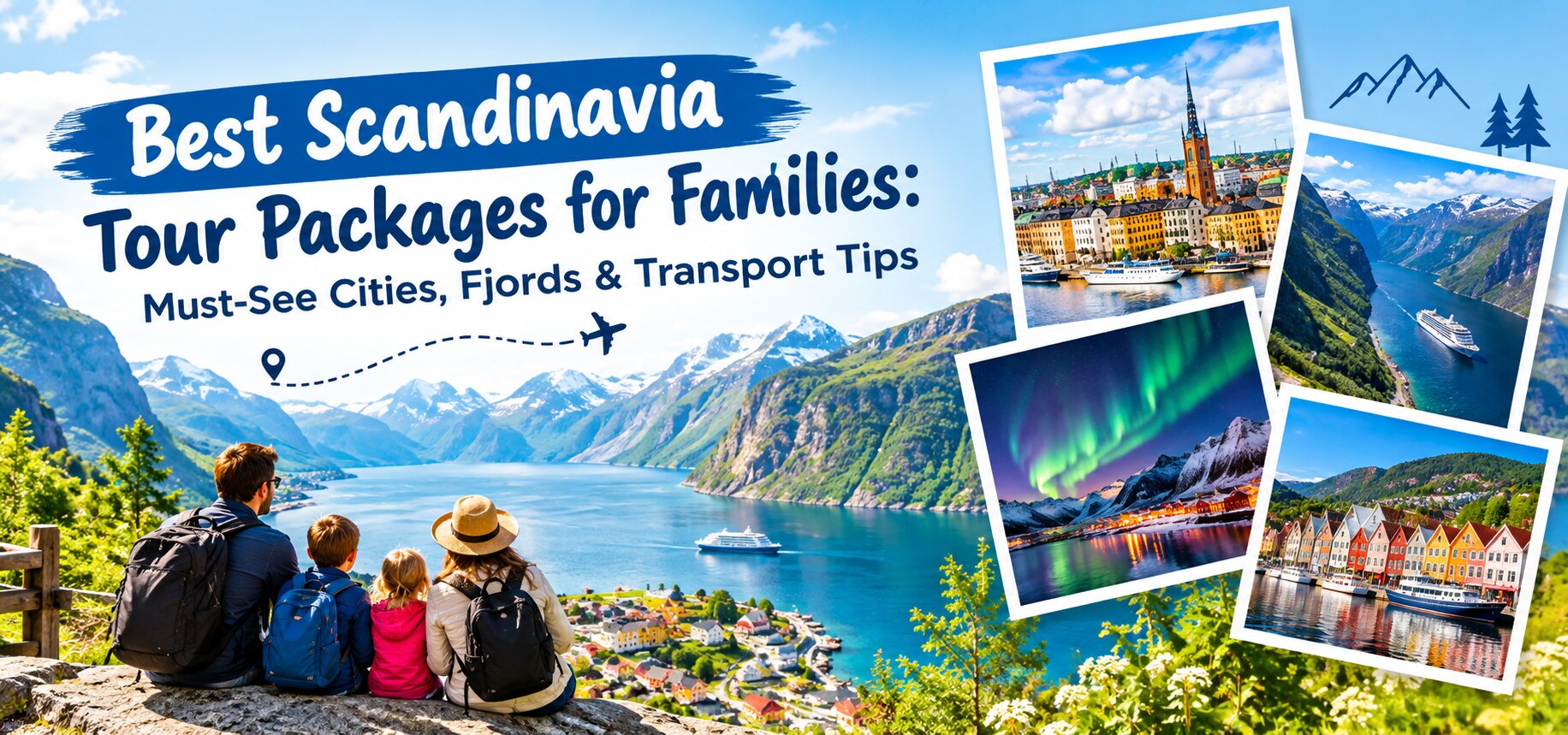
Best Scandinavia Tour Packages for Families: Must-See Cities, Fjords & Transport Tips
September 25, 2026
Finland Honeymoon Packages: Most Romantic Glass Igloo Resorts & Northern Lights Stays
September 18, 2026
Best Time to Visit Australia: Month-by-Month Weather & Travel Guide
September 10, 2026
Top 20 Things to Do in New Zealand for First-Timers (2026)
September 04, 2026
Share article via:


Popular International Destinations!



© 2025 Fliptripholidays.in All rights reserved.
All content and images of this site are copyright of their owners. They are used here only for promotion. Unauthorized use is prohibited and may lead to legal action.



 +91 9999316597
 info@fliptrip.in
 +91 9999316587
 806 A09,
ITL, Northex Tower, NSP, Pitampura
806 A09,
ITL, Northex Tower, NSP, Pitampura